Small Business Defense Against AI Scams: A Practical Playbook
Reading time: about 11 minutes
Small businesses are the sweet spot for AI-powered fraud. They have enough money to be worth attacking and rarely have the dedicated security staff of larger enterprises. According to the Cybersecurity and Infrastructure Security Agency, AI-driven business email compromise, vendor-impersonation fraud, and synthetic-customer fraud now account for the majority of dollar losses among U.S. businesses under 500 employees.
This post is a complete defense playbook for a small business in 2026 — controls, training, and incident response — written in plain English. It assumes no dedicated security team and no enterprise budget. Each section is designed to be acted on by an owner, office manager, or operations lead in a single afternoon.
Inventory: What You Are Actually Protecting
Defense starts with knowing what to defend. Spend an hour writing down the answers to four questions:
What financial accounts can be drained — checking, savings, payroll, line of credit, payment processor balances? Who has access to each?
What customer data do you hold — names, emails, payment cards, IDs, health information? Where is it stored?
What software is critical to operations — accounting, CRM, scheduling, email? Who has admin access?
What vendors can change financial information about your accounts — banking, payroll provider, suppliers? Who at each vendor can authorize a change?
Most fraud follows the answer to one of these questions. Knowing the answers in advance makes you faster than the attacker.
The Five Highest-Impact Controls
The following five controls, implemented well, stop the great majority of AI-powered fraud against small businesses.
1. Out-of-band verification for any wire or ACH change. Any request to change vendor banking, payroll routing, or recipient details requires a callback to a previously stored number, separately from the requesting message. No exceptions.
2. Two-person approval for transfers above a threshold. Pick a number you can live with ($5,000 or $10,000 is common). Above that, two people sign off, using different communication channels.
3. Phishing-resistant MFA on email and primary admin accounts. Passkeys or hardware security keys (FIDO2) on Microsoft 365, Google Workspace, and any account that controls money or customer data. Our passkey guide covers the steps.
4. Password manager for the entire team. Eliminates password reuse, blocks autofill on lookalike sites, simplifies offboarding when employees leave.
5. Daily backups, tested quarterly. Backups protect against ransomware and accidental destruction. Our ransomware action plan walks through the details.
Email And Identity Hygiene
Email is the front door for most attacks. Lock it down.
Use a major email provider with strong filtering — Microsoft 365 Business or Google Workspace. Self-hosted or no-name email lacks the threat intelligence to keep up with AI-generated phishing.
Enable advanced anti-phishing settings (impersonation protection, link rewriting, attachment sandboxing). These are off by default in some plans and dramatically reduce dwell time of malicious mail.
Configure SPF, DKIM, and DMARC on your sending domain. This stops attackers from spoofing your own employees and customers using your domain name.
Remove ex-employee access immediately at departure. Most credential abuse against small businesses involves accounts that were not deactivated promptly.
Vendor And Customer Verification
AI-driven fraud often targets the moments when business relationships change — a new customer, a vendor banking update, a procurement RFP. Tighten these moments.
New vendor onboarding. Verify a new vendor through an independent channel — call the main number, check business registration, search for reviews. Do not rely on documents provided in the inbound communication.
Banking change requests. Every banking change request — even from a long-standing vendor — must be verified by a callback to a previously stored number. This single control prevents the majority of vendor-impersonation losses.
Large new customer orders. Verify the credit and contact information of any new customer making an unusually large initial order. Synthetic businesses use the same patterns as synthetic individuals.
Procurement and RFP responses. AI-written bids may include fabricated qualifications. Verify references with direct calls, not email replies.
Training That Sticks
Annual hour-long training does not change behavior. Short, frequent, scenario-based practice does.
Hold a 15-minute monthly stand-up where one recent scam pattern is discussed and practiced. Real examples from your industry are more memorable than generic case studies.
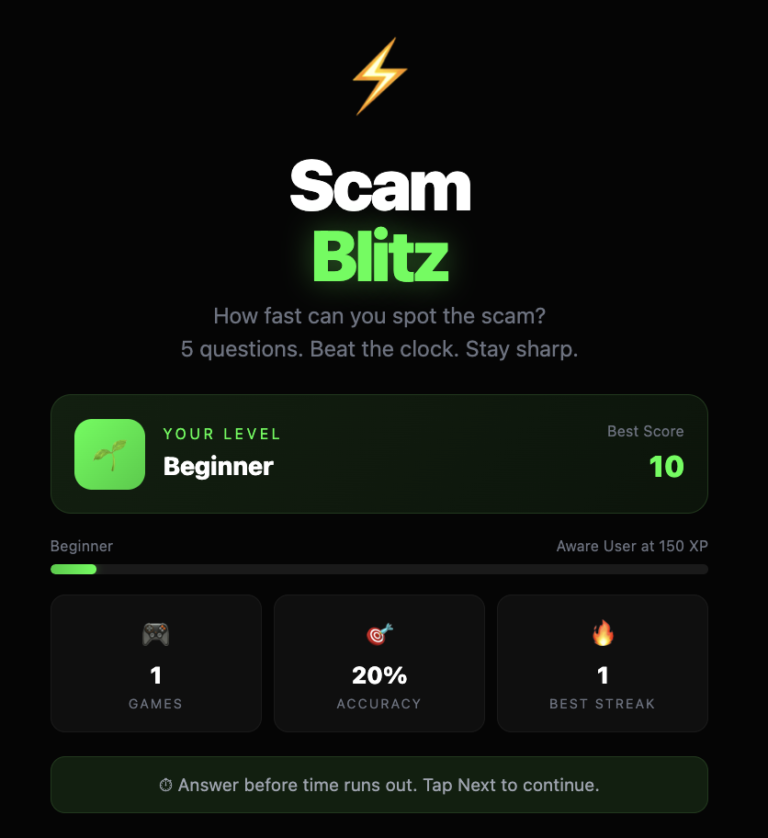
Use lightweight tools that fit into the workday. Scam Blitz and the Scam Detection Game are quick exercises that build pattern recognition without taking a full hour.
Run a simple phishing simulation twice a year — internally or through a vendor — and use the results to focus training. The point is to identify gaps, not to embarrass employees.
Create a culture where reporting is rewarded. “Thanks for flagging that, you saved us a real headache” said publicly to the team is worth more than any technical control.
Incident Response On A Small-Business Budget
Write a one-page incident response plan now, before you need it. It should answer five questions:
Who is in charge if something happens? (Designate a person and a backup.)
What numbers do they call? (Bank fraud line, IT provider, cyber insurance carrier, attorney.)
How are people contacted out of band? (A non-email channel for the response team — a group SMS chain is fine.)
What are the first three steps for the most likely incidents? (Wire fraud: call the bank to recall. Ransomware: disconnect, do not pay, call IT. Email compromise: revoke sessions, reset password.)
Who do we have to notify? (Customers if their data was exposed, regulators in some states, payment processors if cards were involved.)
Store the plan somewhere accessible during an incident — a printed copy in a known location, plus a cloud copy outside the affected systems.
The Annual Refresh
Once a year, walk through the inventory, controls, and plan. Update for new vendors, new tools, new employees. Test backups. Test the callback procedure for a vendor banking change. Rotate any shared credentials. Review who has admin access to email and financial accounts and remove anyone who no longer needs it.
The annual refresh takes about half a day. It costs nothing. It is the highest-leverage cybersecurity activity a small business owner can do.
For ongoing awareness, the Did You Know? app delivers short daily updates that keep the team conversation going.
Common Small-Business Mistakes That Lead To Six-Figure Losses
Post-incident interviews with small businesses that have suffered AI-driven fraud reveal a small set of recurring mistakes. Knowing them in advance protects against the most common patterns.
Treating MFA as optional for senior leaders. The CEO and founder are the most-targeted accounts and yet are often exempted from MFA on the basis of convenience. This single exception accounts for a disproportionate share of major BEC losses.
Storing payment-vendor credentials in shared spreadsheets or unsecured documents. A compromise of one employee’s laptop becomes a compromise of every vendor relationship the business has.
Failing to remove access for departed employees. Most small businesses can describe a recent departure whose accounts were not deactivated for weeks. Audit access quarterly.
No defined incident response. When fraud happens, hours are lost figuring out who to call. The one-page incident plan described earlier in this post takes 30 minutes to draft and saves entire workdays during an actual incident.
Skipping cyber insurance because the business is “too small.” The opposite is true: a single $40,000 wire fraud loss is existential for a 10-person company in a way that the same loss is not for a 1,000-person company. Coverage exists at every business size.
Working Effectively With An IT Provider
Most small businesses do not have in-house security expertise and rely on an outsourced IT provider or managed-services partner. The relationship with that partner is one of the most consequential security decisions the business makes.
A good provider should: enforce MFA on every account they manage, maintain documented backup procedures with regular restoration tests, monitor for unusual sign-ins on email and cloud accounts, and notify you proactively about emerging threats relevant to your industry.
Quarterly conversations with the provider should cover: what changed in the threat landscape, what controls have been added or updated, what employees have been onboarded or offboarded, and what residual risks the provider sees in the environment.
If your current provider cannot articulate answers to these questions in plain language, consider whether the relationship is serving your security needs. The right provider is a partner in defense, not merely a help-desk vendor. Asking the right questions is the first step toward getting the right answers.
Quick-Start: What To Do In The First 30 Days
If the playbook in this post feels overwhelming, focus on the highest-impact actions for the first 30 days. The full set is achievable in a few hours per week across one month.
Week 1: Lock down email and admin access. Enable phishing-resistant MFA on the email accounts of every person who can authorize payments or change vendor information. Move primary admin accounts to passkeys where possible. Audit admin access lists and remove anyone who no longer needs it.
Week 2: Wire and vendor controls. Document an out-of-band verification procedure for wire transfers above $10,000 and for any vendor banking change. Train the finance team. Print and post the one-page quick reference.
Week 3: Backups and incident response. Confirm daily backups are running for every critical system. Test a restoration. Draft and distribute the one-page incident response plan including the phone numbers for bank fraud, IT, cyber insurance, and legal counsel.
Week 4: Training and awareness. Hold a 15-minute team conversation about current scam patterns. Run a small phishing simulation. Establish the rhythm of monthly 15-minute security stand-ups.
Thirty days. Most of the highest-impact controls in place. The remaining work is refinement and ongoing rhythm. Reinforce with quick team exercises on Scam Detection to keep the conversation alive.
Final Note: Security Is A Practice, Not A Project
The temptation when reading a playbook like this is to treat it as a one-time project — implement everything, check the box, move on. Real security looks more like dental hygiene than home renovation. The work is small, frequent, and ongoing; the cumulative effect is durable; and the consequence of skipping it shows up later as a much larger problem.
The annual refresh described above is the rhythm that makes the playbook stick. Half a day each year, plus 15 minutes a month for ongoing awareness, plus the time taken at the moment of each transfer or vendor change to apply the verification routine. That is the entire ongoing investment for a small business with adequate defenses against the great majority of AI-driven fraud.
If your business does nothing else after reading this post, do the one-page incident response plan, enable phishing-resistant MFA on every account that authorizes payments, and document the out-of-band verification procedure for wire transfers. Those three actions, alone, prevent the most common six-figure losses observed in the small-business segment in 2026.
For ongoing team development, work the Scam Blitz game into your monthly stand-up. Five minutes. Real pattern reinforcement. The cost is trivial; the cultural effect compounds.
Frequently Asked Questions
Do I Need A Dedicated Cybersecurity Vendor?
Not necessarily. A reputable IT managed-services provider with security competence is often sufficient for small businesses. Ask specifically about email security, MFA enforcement, and backup verification.
Is Cyber Insurance Worth It?
For most small businesses, yes. Coverage now commonly includes incident response, legal counsel, and forensic investigation in addition to direct loss. Read the application carefully — false answers can void coverage.
How Do I Evaluate A Vendor’s Security?
For SaaS vendors, ask whether they have a SOC 2 Type II report. For services that touch your money or customer data, also ask about MFA, encryption at rest, and breach-notification commitments in writing.
What Is The Single Most Important First Step?
Enable phishing-resistant MFA on the email accounts of everyone who can authorize a payment or change vendor information. That one step prevents the majority of completed business email compromise fraud.